

Context
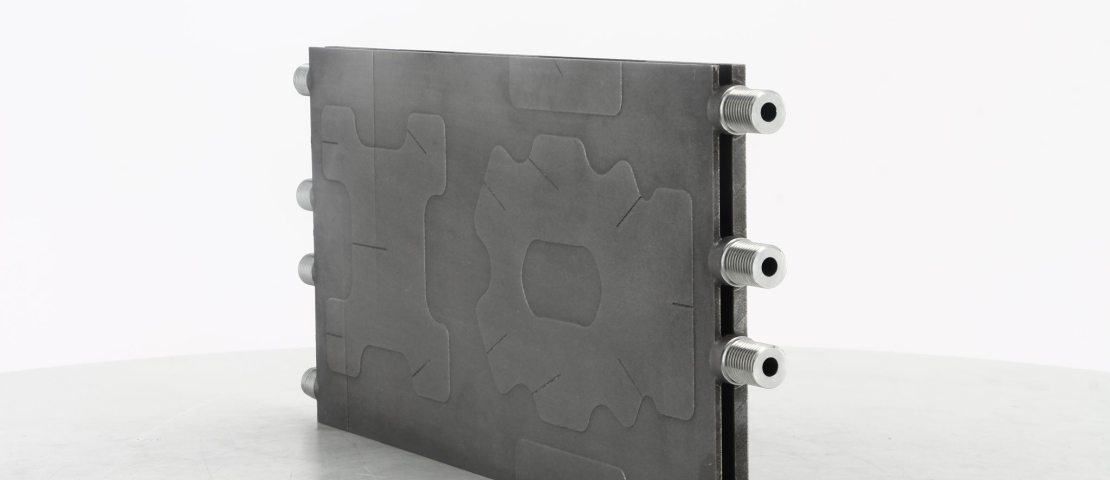
As part of an European Space Agency (ESA)-supported program, we are collaborating with Thales Alenia Space and Epsyl-Alcen to develop metallic heat pipes directly integrated into satellite structures.
The objective is to reduce mass, minimize interfaces, and simplify assembly by embedding the thermal function directly within the structure.
Technical Approach
The heat pipes are additively manufactured in AlSi7Mg aluminum, which is compatible with ammonia, and are directly integrated into LPBF baseplates. Two types of capillary architectures are being investigated:
- Additively manufactured porous structures
- Grooved structures
These geometries are experimentally characterized to evaluate:
- Capillary behavior
- Thermal performance
- Operational limits
Results
Testing demonstrates that these embedded heat pipes provide:
- Excellent thermal performance
- Significant mass reduction
- Simplified assembly compared to conventional solutions
Collaboration and expertise
The project is built on strong synergies between multiple areas of expertise:
- SOGECLAIR: design and additive manufacturing (FormUp 350)
- Epsyl-Alcen: modeling and experimental testing
- Thales Alenia Space: system requirements definition
- European Space Agency: support for technology maturation
This collaborative approach paves the way for more integrated thermal architectures, enabling the design of complex heat pipe geometries and the joint optimization of mechanical and thermal performance from the earliest design stages.


